Path Tracing experiments: Episode 1
Marcos Fajardo, [email protected]
Malaga, August 1999
DISCLAIMER: on-going work, still a rough prototype (slowish!)
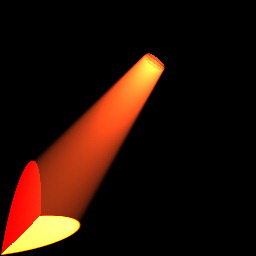
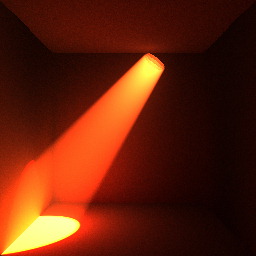
The image on the left was computed with direct lighting only using
deterministic techniques. The image on the right is a Monte Carlo
global illumination solution of the same scene, with 2 indirect
diffuse bounces and 30x30 hermispherical sampling (1800 rays per
pixel), including volume-to-surface as well as surface-to-surface
transport.
[So why is the lit spot red on the wall and yellow on the floor, you say?
Because the left wall is red and the ground, ceiling and back wall
are yellowish.]
2 bounces -- 3x3, 9x9, 16x16, 30x30 samples
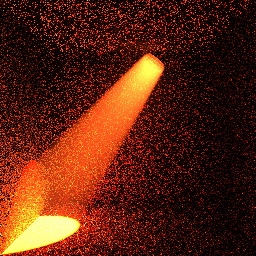
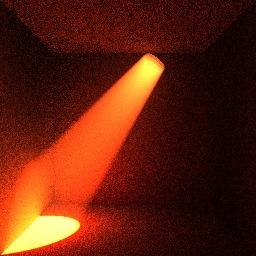
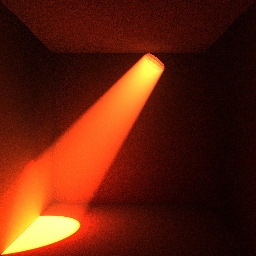
The entire hemisphere of incoming directions is integrated using a
combination of stratified and low discrepancy sampling patterns.
The patterns follow a uniform distribution on the hemisphere, hence
no importance sampling was used. As evidenced in these images, it
takes a large number of samples to reduce the noise to acceptable
levels, especially in diffuse scenes with small sources like this
one. No energy-preserving noise reduction filters were applied.
1, 2, 3 bounces -- 16x16 samples
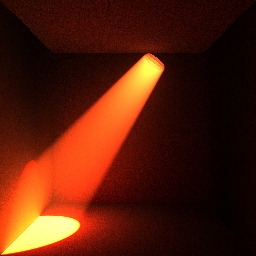
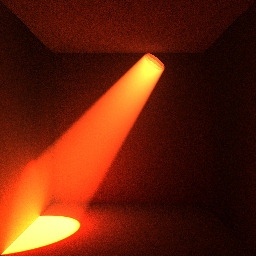
In principle, the recursive radiance equation governing the light
transport process contains paths of infinite length which are
impossible to compute exactly. Fortunately, but only if physically
plausible reflection models are used, the integral operator of
the radiance equation is contractive so higher order terms
contribute much less than the first few terms. In practice, we
truncate the Neumann series expansion after a fixed small number
of terms, introducing bias into the final result. This bias can be
quite significant for highly reflective scenes with mostly indirect
illumination. Russian roulette is a technique that provides an
asymptotically unbiased estimate by using probabilistic termination
of the Neumann series, effectively trading bias for variance, but
it's not implemented in the current prototype.
In this particular test scene, even one or two terms seem to be
enough. Higher order terms don't contribute much to the final image,
but increase rendering times by a linear factor.
Volume-to-surface transport (2 bounces, 30x30 samples)
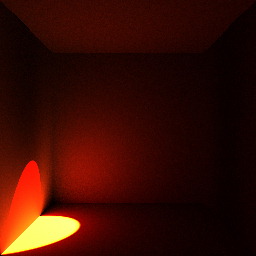
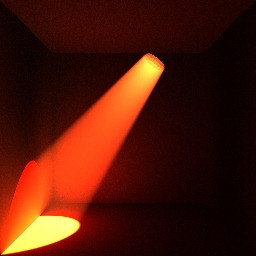
Not only surface-to-surface, but also volume-to-surface transport
is taken into account. Thus, light scatters off the atmosphere
and illuminates the surrounding environment indirectly. A Mie-like
scattering phase function was used, producing forward anisotropic
scattering.
Volume scattering has been disabled completely in the first image,
whereas in the second image it is enabled for eye rays only.
Volume-to-surface interaction is shown in the third image.
© 1999 Marcos Fajardo, [email protected]